

Compound Wafer Product Lineup
AlN
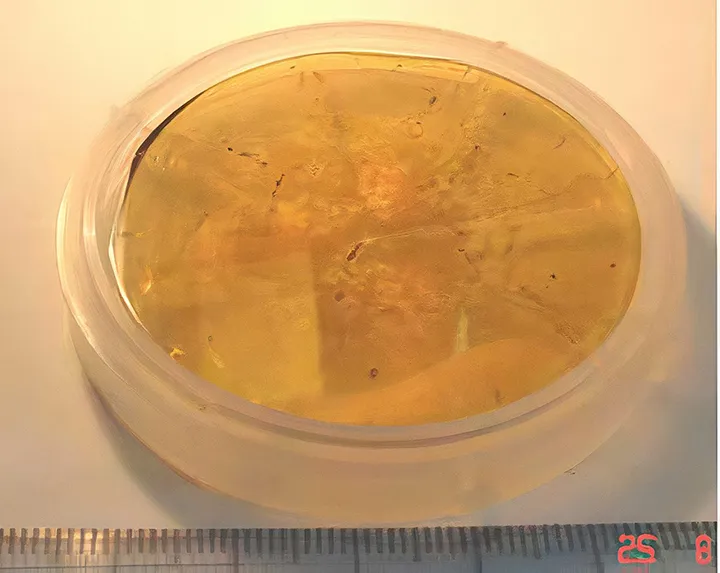
- AlN refers to aluminum nitride, and AlN single crystal substrates are expected to be used in high-efficiency, high-frequency electronic devices as well as deep ultraviolet light-emitting elements.
Using aluminum nitride (AlN) crystals as substrates enables quasi-homoepitaxial growth, which allows the defect density of the stacked nitride crystals to be kept low.
Currently, substrates for nitride semiconductors include sapphire, among others. However, for ultraviolet light-emitting element applications, single crystal substrates are recognized as the best candidates in terms of lattice mismatch and ultraviolet transmittance.
Nonetheless, AlN single crystal substrates have a high melting point and a high dissociation pressure at elevated temperatures, making it difficult to fabricate single crystals from a melt. - Features
- Since 2006, we have been supplying bulk aluminum nitride single crystal substrates, which are cutting-edge materials for blue to deep-ultraviolet lasers and power electronic device development.
Although these are research-grade products, we offer AlN single crystal substrates primarily in diameters of 22.5 mm and 25 mm.(*These are not template products.)
[Main Applications]
UV LEDs/LDs, avalanche photodiodes (APDs), other sensors, power electronic devices, heat sinks, etc.
[Growth Method]
Physical Vapor Transport (PVT)
Sublimation/Seeded-recrystallization of AlN powder
| Item | Description |
|---|---|
| Diameter | 22.5~50mm |
| Thickness | 500±50um |
| Orientation | (0001)±1.0° |
| Finish | Al face:CMP (RMS <0.8nm)
N face:optical (RMS <3nm) |
| Absorption coefficient | <30cm-1 |
| XRD | FWHM (002):<0.3°
FWHM (102):<0.5° |
| EPD | <106cm-2 |
| Effective area | >80% |
| Edge exclusion area | 1.0mm |
GaP
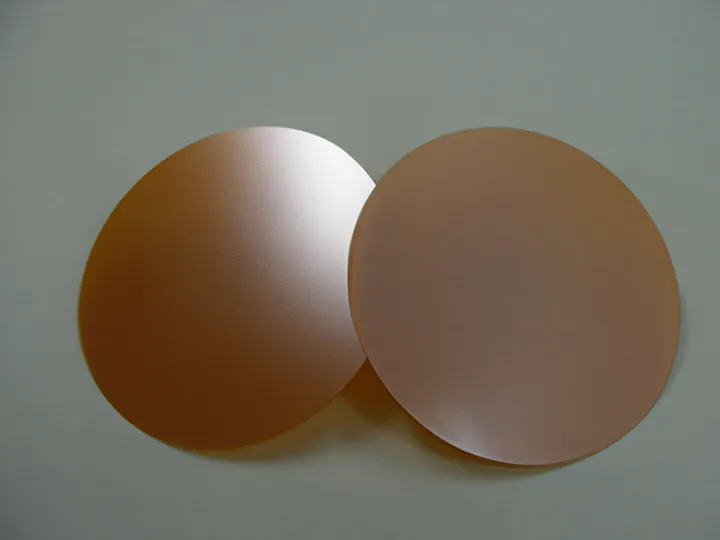
- Gallium phosphide is represented by the chemical formula GaP. It forms orange-yellow translucent crystals and can be obtained through the direct reaction of gallium and phosphorus, or by the reaction of gallium oxide with phosphorus at 900–1000℃.
Specific gravity: 4.13; melting point: 1465°C; dielectric constant: 9.1; bandgap energy: 2.2 eV.As a so-called III–V compound (a compound of group III and group V elements), it exhibits semiconductor properties and is used in visible light-emitting diodes for various display devices, as well as for mobile phone illumination (yellow and green). - Features
- We offer 2inch and 3inch gallium phosphide single crystal substrates. Standard specifications are listed below.
[Main Applications]
Optical devices: various display elements as visible-light LEDs (red, green) and for LCD backlighting (yellow, green), etc.
[Growth Method]
Liquid Encapsulated Czochralski (LEC)
| Item | Description |
|---|---|
| Type/Dopant | N-type/S,Si,P-type/Zn *Un-doped also available |
| Diameter | 2inch ~ 3inch |
| Orientation | (100), (111), (110), and other special orientations, including off-orientations, are also available. |
| Finish | Single side polished, Double sides polished, as-cut |
| Thickness | 250-1000um |
| Carrier concentration | (1-10)E18cm-3 |
| EPD | <1E5cm-2 |
Al2O3(Sapphire)
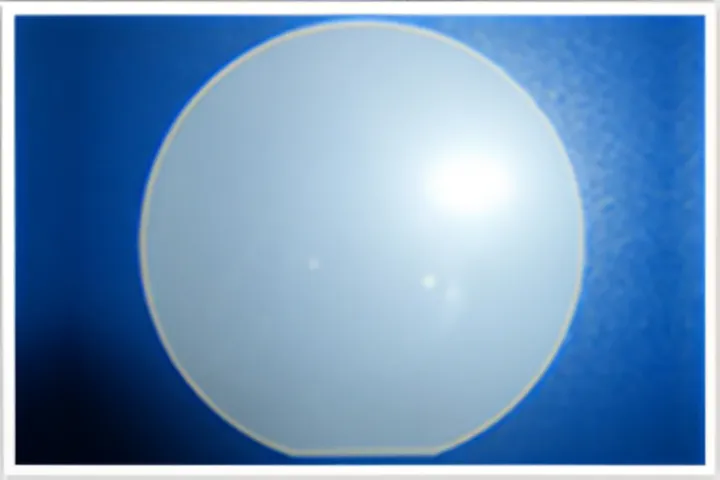
- Aluminum oxide is an amphoteric oxide of aluminum, represented by the chemical formula Al₂O₃.
Commonly known as alumina (α-alumina), it occurs naturally as corundum, ruby, and sapphire. It is primarily used as a raw material for metallic aluminum, and its hardness and high melting point make it suitable for applications as an abrasive and as a refractory material.
Sapphire single crystals used for semiconductor applications are grown by methods such as the CZ method, Kyropoulos method, and EFG method. Sapphire wafers are used as substrates for optical devices, including LEDs and lasers.
In addition, due to its high transmittance over a wide frequency range from the ultraviolet to the infrared, it is also used as an optical window material. - Features
- Sapphire substrates are excellent materials due to their low dielectric constant and crystalline properties. We offer epi-ready substrates in 2inch, 3inch, and 4inch sizes, including standard orientation products as well as customer-specified products (off-orientation products, double-side polished, various thicknesses).
[Main Applications]
For blue LED applications (blue, white, green, and violet LEDs), substrates for gallium nitride crystal growth, etc.
| Item | Description |
|---|---|
| Diameter | 2inch ~ 4inch |
| Orientation | C(0001)0.2off±0.1°to m-axis |
| OF orientation | (11-20)±0.3° |
| OF length | 2inch:16±0.5mm, 4inch:30±1.0mm |
| Thickness | 2inch:430um, 4inch:650um |
| Finish | Single side polished |
| Bow | ≦10um (2inch) |
| TTV | ≦10um (2inch) |
SiC
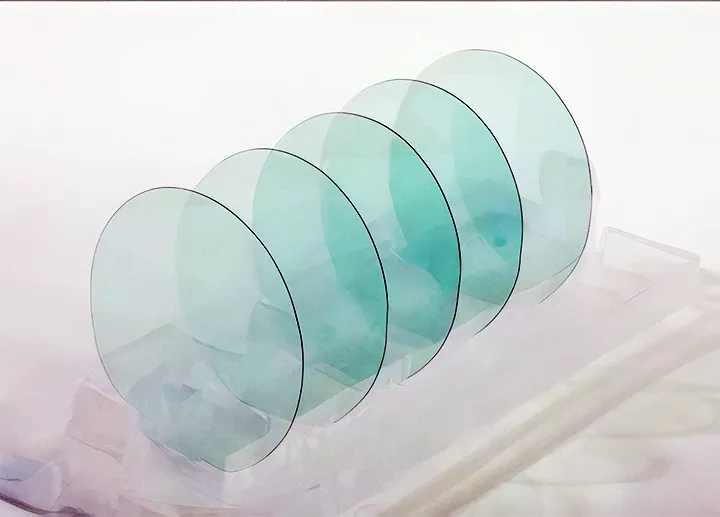
- Silicon carbide (chemical formula: SiC) is a compound of carbon (C) and silicon (Si) with strong covalent bonding. It has a bandgap of 3.2 eV, approximately three times that of silicon.
It has high thermal conductivity and excellent heat dissipation and heat resistance, with properties far superior to conventional silicon (Si) wafers.
As a material that significantly reduces device power loss and enables high efficiency and energy savings, it is expected to see growth in applications such as automotive (hybrid and electric vehicles), home appliances (air conditioners, solar cells, etc.), power, and information and communication technologies. - Features
- We offer 2–4 inch SiC wafers for a variety of applications.
*SiC epi wafers are also available.
GaN
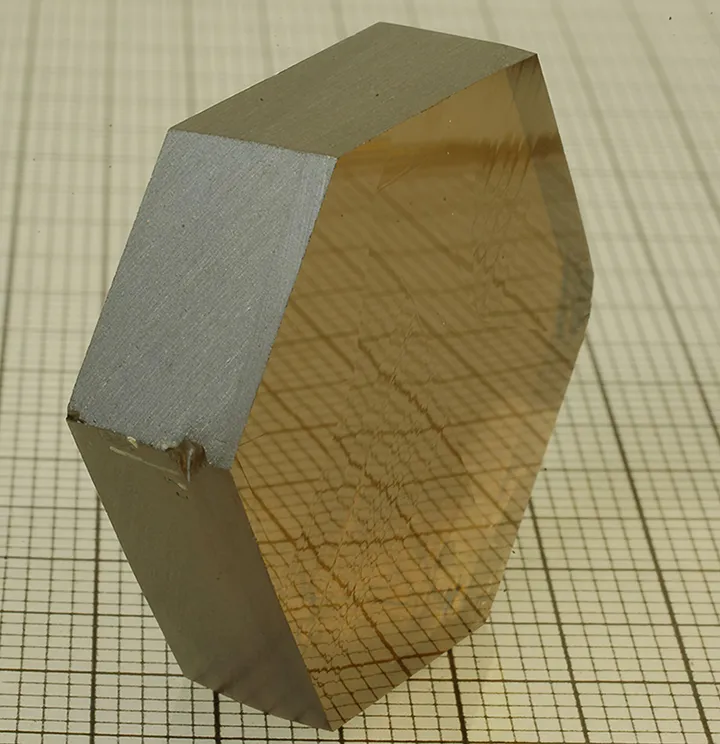
- Gallium nitride is a nitride of gallium. It is widely used as a substrate for light-emitting diodes (blue, violet, ultraviolet, and white LEDs) and for blue-violet LDs (laser diodes) used in Blu-ray applications.
Traditionally, most gallium nitride substrates have been those in which a gallium nitride layer is deposited on a sapphire substrate.
Nowadays, to meet the demands of high-power and high-durability applications such as LDs and high-brightness LEDs, there has been active product development of free-standing substrates that are less prone to crystal defects. - Features
- We offer high-quality GaN bulk substrates for LED, LD, and electronic device applications (available in sizes up to 2inches).
*GaN epi wafers are also available.
Ge
- Germanium (chemical symbol: Ge) has a narrower bandgap (approximately 0.7 eV) than silicon. It was used in early transistors and was the dominant material until silicon, which offers superior stability, became widely adopted.
Even today, due to its low forward voltage drop, germanium is used in diodes, and its relatively narrow bandgap makes it suitable for photodetector applications.
It is also used in gamma-ray radiation detectors, infrared optical applications, and solar cells. - Features
- We offer 2–4 inch Ge (Germanium) wafers for applications such as infrared devices, solar cells, and detectors.
Oxide
- Many oxide semiconductors have a wide bandgap and are transparent to electromagnetic waves in the visible spectrum.
Some of these exhibit high charge carrier concentrations and mobilities, and are used in various applications that leverage these properties, such as transparent conductive films, superconductors, and sensors.
Representative oxide single crystal substrates include strontium titanate (SrTiO3) single crystal substrates and magnesium oxide (MgO) single crystal substrates, used for superconducting thin film substrates. - Features
- We offer various oxide single crystal wafers, including MgO (magnesium oxide), SrTiO3 (strontium titanate), and ZnO (zinc oxide).
II-VI Compounds Wafer
- II-VI semiconductors are compounds composed of group II and group VI elements. Commonly used group II elements include magnesium, zinc, cadmium, and mercury, while commonly used group VI elements include oxygen, sulfur, tellurium, and selenium.
Examples of compounds formed from these elements include ZnO (zinc oxide), CdTe (cadmium telluride), ZnSe (zinc selenide), and ZnS (zinc sulfide).
II-VI semiconductors are highly ionic and generally hard but brittle. On the other hand, their bandgap can be significantly modified by changing the composition.
Those with bandgaps corresponding to the visible or infrared regions are used as materials for light-emitting and light-detecting devices. - Products
-
- CdSe (Cadmium Selenide single crystal)
- CdS (Cadmium Sulfide single crystal)
- ZnSe (Zinc Selenide single crystal)
- ZnTe (Zinc Telluride single crystal)
- ZnS (Zinc Sulfide single crystal)